Facts and Figures

Number of Volumes 15
Number of Issues 47
Number of Articles 281
Number of Contributors 586
Article View 169,603
PDF Download 119,449
View Per Article 603.57
PDF Download Per Article 425.09
Number of Submissions 596
Rejected Submissions 345
Accepted Submissions 213
Acceptance Rate 36
Peer Review Process 95
Number of Indexing Databases 6
Number of Reviewers 410


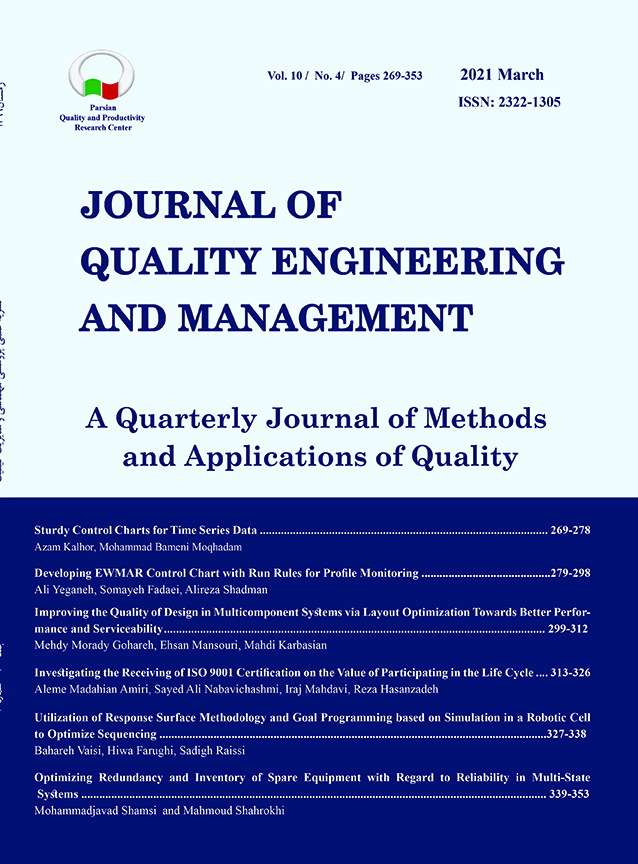
Journal of Quality Engineering and Management (JQEM) 


The Journal of Engineering and Quality Management aims to provide a scientific platform for researchers in the fields of Quality Engineering, Quality Management, Industrial Engineering, Management, and related interdisciplinary areas to share and disseminate their latest scientific findings. The journal seeks to introduce and examine contemporary issues in quality engineering and quality management at a level that is useful for students, professionals, and stakeholders interested in quality improvement and productivity enhancement.

The Journal of Engineering and Quality Management is a closed peer-reviewed, open-access journal published quarterly and online. It is expected that this journal will contribute to the advancement of the scientific capabilities of researchers. Therefore, all experts, faculty members, researchers, and industry practitioners are invited to submit the results of their original and unpublished research for evaluation and publication in this journal.

“It should be noted that only manuscripts which have not been previously published in other journals or
conference proceedings will be considered for publication in this journal.”


Attention to Graduate Students (Master’s and PhD Programs):

  • Please pay careful attention to the order of authors’ names, their institutional affiliations, and related details when submitting your manuscript. After submission of the article to the journal, none of the aforementioned items can be changed under any circumstances.
  • The acceptance certificate of the article does not include the publication date or issue number (it should be noted that accepted articles will be published within 18 months; however, this timeframe is not definite and is not legally binding).
  • For further information, please refer to the About the Journal section.


Original Article

An improved E2-Bayesian estimator for the efficiency parameter of an infinite-capacity multi-server queueing system

Pages 1-14

https://doi.org/10.48313/jqem.2025.553995.1579

Shahram Yaghoobzadeh Shahrastani, Iman Makhdoom

Abstract Purpose: The study aims to develop a new Bayesian estimation approach, termed the E2-Bayesian method, for estimating the traffic intensity parameter in the multi-server M/M/c/∞ queueing system. Given the crucial role of accurate efficiency estimation in optimizing service systems, this research addresses the need for more reliable inference under uncertainty. Methodology: The M/M/c/∞ queueing model, characterized by servers, exponential interarrival times with rate parameter λ, and exponential service times with rate parameter μ, is considered. The traffic intensity parameter is estimated using Bayesian, E-Bayesian, and the newly proposed E2-Bayesian methods under the general entropy loss function. The performance of the proposed estimator is assessed through Monte Carlo simulation and validated using a real dataset. Findings: Simulation results and empirical analysis demonstrate that the proposed E2-Bayesian estimator outperforms the traditional Bayesian and E-Bayesian estimators in terms of efficiency and accuracy. The estimator that minimizes the mean waiting time of customers in the queue is identified as the optimal choice. Originality/Value: This research introduces a novel E2-Bayesian estimation approach that enhances the precision of parameter estimation in queueing models under uncertainty. The integration of the general entropy loss function provides a flexible and robust framework, contributing to the advancement of Bayesian inference in stochastic systems.
Original Article

Bi-objective Optimization of Active Redundancy Allocation in the Electrical Power Distribution System of a Marine Vessel Considering Load Sharing and a Single Repairman

Articles in Press, Accepted Manuscript, Available Online from 31 January 2026

https://doi.org/10.48313/jqem.2026.546474.1574

maryam ganji

Abstract Purpose: The objective of the present study is to determine an optimal configuration in terms of the type and number of components in order to maximize system availability and reduce costs, using an active redundancy allocation strategy, while considering load-sharing capability and the use of maintenance personnel under maintenance and leave policies, in the electrical power distribution system of a marine vessel. In the active redundancy strategy, all additional components and subsystems are operated simultaneously from the start of system operation, and the system fails only when all components have failed.
Methodology: In this study, a bi-objective model is developed for an electrical power distribution system with active redundancy in a marine vessel, where the first objective is minimization of total cost and the second objective is maximization of system availability. System behavior is simulated using a Markov chain and a phase-type distribution, and the model is solved using the Non-dominated Sorting Genetic Algorithm II (NSGA-II). Failure of one component affects the failure rates of other components within the same subsystem, leading to an increase in their failure rates. In other words, the problem is analyzed under a load-sharing condition. A single repairman is considered for equipment repair. The maintenance and leave policy is defined such that if a component fails during the repairman’s leave period, the leave is terminated and repair of the failed component begins immediately. If another component fails while a component is under repair, it is placed in a repair queue, and the repairman starts repairing the next failed component immediately after completing the repair of the previous one. When the repairman is on leave and no component failure occurs, the repairman may resume the leave period.
Findings: The results of the study identify the optimal combination of the type and number of electrical power distribution panels in each subsystem of the vessel’s electrical power distribution system, aimed at increasing system availability and reducing costs through the use of active redundancy. In addition, the results provide the probability of the repairman being busy, which can support managerial decision-making regarding maintenance and leave policies.
Originality/Value: Considering the innovative aspects of the study, the results can be effectively used for engineering analyses, particularly in evaluating system availability, as well as for managerial analyses, including cost estimation and the allocation of maintenance personnel.

Original Article Industry-Specific Applications and Emerging Quality Trends

Determining the Factors Influencing the Prediction of Helicopter Rotor Failures

Articles in Press, Accepted Manuscript, Available Online from 18 May 2026

https://doi.org/10.48313/jqem.2026.555331.1581

Mahsa Babaee, Jafar Gheidar-Kheljani, Mostafa Khazaee, Mahdi Karbasian

Abstract Determining the Factors Influencing the Prediction of Helicopter Rotor Failures
Purpose: The purpose of this paper is to investigate and identify the variables that influence the occurrence of helicopter accidents caused by different types of rotor failures. These crucial factors include flight conditions, maintenance conditions, and helicopter configuration. With this approach, accidents can be investigated more effectively and flight safety can be significantly improved.
Methodology: By analyzing 135 rotor faults accident from a comprehensive dataset containing 5652 helicopter-related accidents, eight classes of rotor faults were identified. Based on expert surveys and a review of studies in the field of helicopter accidents, nine features were proposed as crucial factors to such accidents. The significance of these factors was assessed using five feature selection methods. The input features included maximum takeoff weight, flight hours since the last inspection, type of last inspection, engine power, flight hours, altitude, wind speed, wind direction, and flight phase. Five well-known feature selection techniques—Correlation Matrix, Extreme Gradient Boosting (XGBoost), Mutual Information, Deep Learning, and Neural Network—were employed to identify the most essential factors.
Findings: "Maximum weight", "helicopter engine power", "flight phase" and "flight hours" were identified as variables with the highest degree of importance in predicting faults class of helicopter rotor, which also have a strong and acceptable justification in flight mechanics.
Originality/Value: The distinction of the present study from similar works lies in the inclusion of a broader range of variables, such as flight conditions and helicopter configuration, in contrast to previous studies that considered only a limited set of variables. By prioritizing these variables, the findings pave the way for proactive measures to prevent rotor faults, aiming to enhance prediction accuracy, reliability, and flight safety.

Analysis of heterogeneity and transmission mechanism of the effect of FinTech innovation on banks' risk-taking behavior (Models: DID, 2SLS-IV, GMM)

Volume 14, Issue 3, Autumn 2024, Pages 253-271

https://doi.org/10.48313/jqem.2024.219199

Alireza Shirali, Mostafa Heidari Haratemeh

Abstract Purpose: Traditional banking needs new FinTech innovations and technologies to improve its processes and services. FinTech innovations have led to significant changes in the banking system, including advancements in risk management. Therefore, the present study aimed to investigate and analyze the heterogeneity and the mechanism underlying the effect of FinTech innovation on the risk-taking of commercial banks using balanced panel data from 20 banks for the period 2013-2022. Methodology: Based on web technology, an indicator at the bank level is considered, including the creation, annual number, and frequency of news related to fintech innovation from each bank. This indicator is calculated as the ratio of the value of online shopping and bill payments made through the Internet and mobile devices to GDP. To address potential endogeneity issues, including measurement errors and omitted variables, the methods of Instrumental Variables (IV) and Difference-in-Differences (DID) were employed to test the hypothesis and obtain consistent estimates. Findings: Showed that improvement in FinTech bank innovation significantly reduces risk-taking. The results of the mechanism analysis indicate that a bank's FinTech innovation reduces its risk-taking through two channels: increasing operating income and enhancing the capital adequacy ratio. The analysis of the heterogeneity of bank size, bank type, and competitiveness shows that larger, public, private, and highly competitive commercial banks have a more pronounced effect on reducing risk-taking in the development of technological innovation. Also, robustness and stability tests, including changing the methods used to construct the FinTech innovation index, replacing risk-taking indicators, and reducing the change in the study sample, showed that the findings remained unchanged. Originality/Value: The banking system should adopt a development model aligned with the era and utilize FinTech solutions to accelerate its digital transformation. Finally, since the use of FinTech by commercial banks presents certain potential risks, banks should enhance their risk management. Implement applicable supervisory measures, such as information disclosure standards and risk management indicators.

Presenting a fuzzy mathematical programming model for allocating and scheduling parts in a flexible manufacturing system (FMS) and the impact of repairs and maintenance on product quality

Volume 14, Issue 2, Summer 2024, Pages 105-126

https://doi.org/10.48313/jqem.2024.215017

Jafar Hassan Beigi, Meghdad Jahromi, Mohammad Taghipour

Abstract Purpose: This study aims to develop a mathematical model for flexible job shop scheduling. The primary focus is on optimizing three objectives: the makespan, the maximum machine workload, and the total workload. The ultimate goal is to enhance productivity and flexibility in manufacturing systems.
Methodology: Two metaheuristic algorithms, NSGA-II and MOGWO, were used to solve the model. The model was first validated on a small scale, and then a sensitivity analysis was conducted on larger instances. The performance of the algorithms was compared based on accuracy and solution quality metrics.
Findings: The results indicate that MOGWO performs better on medium-sized problems, whereas in large-scale cases, the difference between the two algorithms is not significant. The highest sensitivity was observed among the objectives regarding production and maintenance costs. Additionally, a resource-allocation pattern and an optimal sequence of operations were derived.
Originality/Value: The originality of this research lies in developing and applying a multi-objective mathematical model for flexible job-shop scheduling that considers real-world constraints, including costs and resource limitations. The simultaneous use and detailed comparison of NSGA-II and MOGWO across different problem sizes is another contribution. Furthermore, the proposed operational pattern improves the applicability of the results in industrial environments.

Digital Transformation and Industry 4.0 in Quality Management

Designing a causal model to improve the quality of supervision of banks and credit institutions based on the type of mission

Volume 15, Issue 2, Summer 2025, Pages 110-136

https://doi.org/10.48313/jqem.2025.532443.1561

Mehdi Rameshg, Mohammad Javad Mohagheghneya, Moslem Peymani, Vahid Khashei Varnamkhasti

Abstract Purpose: The existing supervisory system in many countries, especially in Iran, mainly uses general and integrated models in which the structural, mission, and operational differences between banks and financial institutions have not been properly taken into account. This uniform approach has led to reduced risk identification accuracy, a lack of adaptation to each financial institution's specific needs, and reduced effectiveness of supervisory measures. The main objective of the present study is to design a cause-and-effect model to improve the quality of supervision based on the mission type of banks and financial institutions, using a mixed approach (Meta-Synthesis-Fuzzy DEMATEL).
Methodology: The present research was conducted using a mixed method (Qualitative-quantitative) and exploratory approach. Then, using a survey, 25 banking industry experts with at least 10 years of executive experience in finance and banking and master's and doctoral degrees were recruited to examine the validity and reliability of the proposed model. Also, paired-comparison questionnaires were distributed to the experts, and the intensity of impact and effectiveness between the research dimensions were examined using the fuzzy multi-criteria decision-making technique, DEMATEL.
Findings: The research findings show that using the meta-synthesis approach, 9 dimensions and 40 components were selected. They were selected from the dimensions. Also, the results of fuzzy DEMATL analysis show that the most influential dimension of the present study regarding the supervision of banks and credit institutions based on the value of (D+R) is the legal and regulatory supervision dimension among the independent dimensions and the cause with the highest value and the most influential variable. Also, among the dependent and affected dimensions based on the lowest value (D-R), the environmental and social performance dimension was recognized as the most influential variable in improving the quality of supervision of banks and credit institutions.
Originality/Value: Using a meta-combination approach in the analysis of previous research, which can provide new horizons for designing effective models based on improving the quality of banking system supervision. Therefore, the present study is of high scientific and practical importance for advancing methodology, responding to the current needs of the country's financial system, and improving the effectiveness of supervision of monetary institutions. This research has also led to recognition of the intensity of the relationships among the dimensions of quality improvement in banking industry supervision and has drawn more attention to these components.

Analyzing the quality of digitalization in supply chain collaboration models using an integrated fuzzy BWM-TOPSIS approach

Volume 14, Issue 3, Autumn 2024, Pages 224-243

https://doi.org/10.48313/jqem.2025.516446.1513

Shahab Bayatzadeh, Hamidreza Talaie, Ali Sorourkhah

Abstract Purpose: This study aims to evaluate and rank collaboration models in the Iranian rubber industry supply chain from the perspective of digitalization quality. Digitalization quality refers to the effective use of Industry 4.0 technologies to improve transparency, integration, agility, resilience, and sustainability. The rubber industry was selected due to its operational complexity and urgent need for digital transformation. Methodology: A multi-criteria decision-making approach was adopted, combining the Fuzzy Best-Worst Method (BWM) for weighting the evaluation criteria and TOPSIS for ranking the collaboration models. A sensitivity analysis was also conducted to assess the robustness of the results across varying criterion weights. Findings: The digital supply chain model ranks highest in digitalization quality, with "technology integration" as the most critical criterion. The sensitivity analysis confirms the rankings' robustness and stability across different weight scenarios. Originality/Value: This research uniquely addresses the comparative assessment of collaboration models in the rubber industry based on digitalization quality. The use of a Fuzzy BWM-TOPSIS hybrid method and comprehensive sensitivity analysis provides a novel, practical framework for strategic decision-making in digital supply chain transformation.

Modeling a sustainable and resilient supply chain in the automotive industry

Volume 14, Issue 4, Winter 2025, Pages 379-406

https://doi.org/10.48313/jqem.2025.514088.1508

Seyedeh Mahboubeh Saeidifar, Iraj Mahdavi, Ali Tajdin, Nikbakhsh Javadian

Abstract Purpose: This work addresses the automotive industry with two important, evolving concepts: sustainability and resiliency. The proposed model is designed to balance economic, environmental, and social objectives while maintaining adaptability to potential supply chain changes and disruptions. A real automotive company is then investigated as the case study to assess the applicability, validity, and performance of the developed model and, eventually, render useful managerial and decision aids. Methodology: To achieve this objective, a comprehensive decision-making model has been developed. In the first stage, supplier evaluation is conducted based on sustainability and resilience criteria. This assessment employs two innovative decision-making approaches: the stochastic fuzzy Best-Worst Method (BWM) and stochastic VIKOR. In the subsequent stage, a multi-objective mathematical model is formulated by incorporating stochastic-fuzzy uncertainty. To solve the model, a fuzzy robust optimization approach combined with a modified multi-choice goal programming method based on a utility function is applied. Findings: In this study, the supply chain of SAIPA Kashan Automotive Company is analyzed across three key dimensions: general criteria, sustainability, and resilience. Indicators such as cost, quality, and reductions in energy consumption were identified as the most critical evaluation factors. Supplier evaluation and ranking were carried out using the fuzzy VIKOR method. The results indicate that, among the main suppliers, the second and fifth options, and among the backup suppliers, the second option, received the highest scores. Furthermore, to assess the robustness and validity of the proposed approach, the results were compared with those obtained using conventional methods. Originality/Value: The value of this research lies in presenting a comprehensive decision-making model under uncertainty and in improving supply chain performance across economic, environmental, and social perspectives. The findings can significantly assist managers and policymakers in the automotive industry in addressing complex supply chain challenges.

An analysis of the barriers to the implementation of quality 4.0 utilizing the approach fuzzy DANP

Volume 14, Issue 4, Winter 2025, Pages 304-320

https://doi.org/10.48313/jqem.2025.217977

Davod Andalib Ardakani, Fatemeh Zamzam, Mehrdad Kiani

Abstract Purpose:  This research aims to identify and examine the relationship between the barriers to implementing Quality 4.0 in the Yazd tile and ceramic sector.
Methodology: A systematic review was employed to identify and categorize barriers, while the combined Fuzzy DEMATEL-ANP (FDANP) method was used in the quantitative phase to elucidate the relationships among these barriers and to prioritize them.
Findings: The qualitative analysis revealed 18 barriers across four categories. The Quantitative findings indicated that "High Cost of Implementation and lack of transparency in Return on Investment" emerged as the most causal barrier, while "failure to consider Quality 4.0 as a strategic issue and source of competitive advantage" was identified as the most consequential barrier to implementing Quality 4.0 in the Yazd tile and ceramic industry. Also, the key obstacles to the implementation of Quality 4.0 in the Yazd ceramic and tile industry include the lack of quantitative metrics for assessing the impact of Industry 4.0 on quality, the failure to consider Quality 4.0 as a strategic issue and a source of competitive advantage, the absence of advanced training programs for personnel, insufficient financial resources for implementing Quality 4.0, and the lack of stakeholder involvement in Quality 4.0 initiatives and projects.
Originality/Value: This study employs a hybrid Fuzzy DANP approach to support managers and decision-makers in strategizing for overcoming obstacles to the adoption of Quality 4.0. It achieves this by identifying barriers, determining their interrelationships, and prioritizing them.

Optimal stock portfolio quality management using the combination of the Markowitz model with support vector machine methods, data envelopment analysis, and DB scan

Volume 14, Issue 4, Winter 2025, Pages 358-378

https://doi.org/10.48313/jqem.2025.513904.1510

Reza Khosravi, Jamshid Peikfalak, Hassan Fattahi Nafchi

Abstract Purpose: This study aims to determine the optimal stock portfolio using a combination of the Markowitz model with Support Vector Machine (SVM), Data Envelopment Analysis (DEA), and the DBSCAN clustering algorithm. The statistical population consists of companies listed on the Tehran Stock Exchange from 2012 to 2022. Methodology: To achieve the research objectives and form an optimal stock portfolio, dimensionality reduction approaches, DEA, SVM, and the DBSCAN clustering algorithm were employed. Financial ratios derived from balance sheets, income statements, and cash flow statements, as well as composite financial ratios and risk-return analysis based on the hybrid Markowitz model, were used as inputs to construct four portfolios. Findings: The SVM method and the fourth approach, which includes the hybrid model, exhibited superior performance in optimizing the stock portfolio. Originality/Value: Given the innovation of this research in applying the hybrid Markowitz model, the results can assist investors and stock analysts in managing the quality of an optimal stock portfolio.

Title proper:

Mohandesi va modiriyat keyfiyyat

Persian title: 

نشریه مهندسی و مدیریت کیفیت

Parallel title (English):

Journal of Quality Engineering and Management (JQEM)

 ISO Abbreviation: 

J. Qual. Eng. Manag. 

Publication Information
Indexing and Abstracting

Keywords Cloud